








Mitigation: Emission Reduction Roadmap
Mitigation: Emission Reduction Roadmap
Sasol’s operations account for approximately 10% of South Africa’s total greenhouse gas (GHG) emissions. While South Africa contributes less than 1% to global emissions, we recognise the significance of our role in the global climate response. South Africa is also a signatory to the Paris Agreement, reinforcing the country’s commitment to climate action. As a responsible corporate citizen, Sasol is committed to supporting the transition to a lower-carbon future through meaningful and sustained efforts.
With our optimised ERR, we can decarbonise and:
 Achieve air quality compliance
 Lower operational cost and reduce environmental impact
 Create the foundation for a power business
 Expand product portfolio to include sustainable fuels and chemicals
 Employ high-integrity, real and independently assured market-based instruments
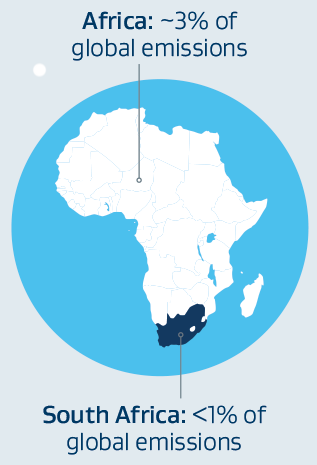
Sasol’s greenhouse gas (GHG) emissions in context
Sasol contributes ~10% of South Africa’s total emissions
Africa accounts for ~3% of global emissions, with South Africa contributing <1% of these global emissions
Our Commitment: Emission Reduction with Value Creation
At our FY25 Capital Markets Day, we announced an optimised Emission Reduction Roadmap (ERR), refined to be more economically viable than our previous base case, while still meeting all compliance obligations and enabling us to achieve our decarbonisation targets.
This updated roadmap keeps us firmly on track to deliver a 30% reduction in Scope 1 and 2 GHG emissions by 2030.
Our optimised plan is the clearest proof yet that Sasol can lower carbon emissions while unlocking growth and value. We will be achieving our emissions targets under significantly improved operating and financial conditions. How is this possible? Three key shifts unlocked this breakthrough:
- Regulatory Certainty
In 2024, South Africa’s Environmental Minister confirmed load-based SO₂ limits for our boilers. This clarity enables us to keep more boilers in operation, preserving critical steam capacity while remaining compliant. With this certainty, we’ve stopped scaling back gasifier use and are now maximising production at Secunda.
This also allows us to cut capital expenditure, by shifting away from fine coal recycling and progressing alternative, lower-cost solutions.
- Accelerated Renewable Energy Deployment
We’ve expanded our ambition to deploy 2 Gigawatts of renewable energy, displacing expensive, coal-based electricity. This not only reduces emissions but delivers competitive returns and strengthens our energy resilience.
- Leveraging Offsets and Renewable Energy Certificates (RECs).
To help close the remaining gap to our 2030 target, we are leveraging carbon offsets and RECs. Sasol has long used offsets to manage our carbon tax liability, and now, these same offsets will also support our emissions reduction goals. They provide flexibility for managing hard-to-abate residual emissions.
A Roadmap that Unlocks Growth
When you put it all together, the result is a roadmap that is no longer just about mitigation, it’s a catalyst for growth.
- Lower capital, higher returns: This allows us to reduce debt faster and accelerate growth initiatives.
- Full gasifier utilisation: Secunda continues to deliver strong cash flows well into the future.
- A future power business: We’ve planted the seed for a scalable, integrated power business with standalone economics.
Tangible Progress
Our progress is already visible:
- Energy efficiency projects have enabled us to shut down our first boiler-equivalent unit in Secunda.
- All onsite incinerators in Sasolburg and Secunda have been decommissioned, with most waste streams now being recycled.
- Renewable energy is already flowing into our operations.
The Bottom Line
Sasol’s optimised ERR delivers more than just lower emissions, it creates economic value and strategic flexibility. This is innovation in action, and our stakeholders can expect more as we continue to respond to a rapidly evolving external environment.